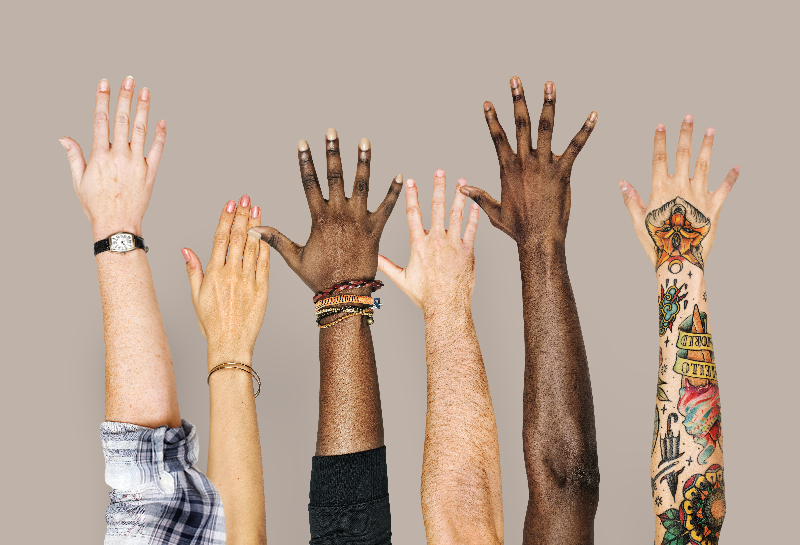
I don’t usually get too controversial on this blog, but have you heard what’s going on at Moda? They are launching the BlockHeads 7 Sew Along, starting Oct. 7. They have advertised on Instagram (click link) and Facebook a photo lineup of the 30 designers contributing to this year’s BlockHeads. All 30 of them are white women. Most are well-known and extremely talented. No shade to them.
However, no men, and no people of color are participating. This year’s theme is “Welcome to our Neighborhood Where There’s Always Room for More” or something close to that. Moda is getting huge backlash of criticism for its lack of diversity. People are leaving comments like “That doesn’t look like my neighborhood,” and “That’s a low-volume lineup,” and “Seems like you have embraced the Pantene Color of the Year,” which is a creamy white called Cloud Dancer.
You get the drift.
Josh Dunn is the new president of Moda Fabrics, having just taken over from his dad, Mark Dunn. He has issued a public statement saying that Moda will do better going forward. I thought his remarks sounded sincere (click link) and were well said.
Arguably, the typical demographic of quilters is middle-aged and retired white women who are privileged enough to afford an expensive hobby like quilting. That being said, Moda does have male designers (Doug Leko and Christopher Wilson-Tate), and also women of color designers (Jen Hewett, and Rashida Coleman-Hale). Why were they not asked to participate in BlockHeads 7?
I believe more diversity could strengthen the quilting world in many meaningful ways. Quilting has a rich history that crosses cultures, generations, economic backgrounds, and artistic traditions, and making more room for those perspectives can expand what quilting looks like and who feels welcome within it.
What do you think?
18 Responses
Thanks for bringing this up, Nicole. I haven’t kept track of Blockheads and didn’t know about the controversy until a friend reposted the United Notions response on her FB page. Now I’ve looked it up. What impresses me is that so many people noticed the “low-volume” designer lineup (as one commenter said).
I also didn’t know about this so thank you for posting about it. Shame on Moda. I agree about the dynamic but honestly, they have designers who are men and people of color and they still didn’t include them?
I saw that and it really made me sad. Such an unforced error because Quiltcon did the same thing with their list of teachers recently. Unfortunately, they used everyone’s portrait instead of a company logo— it was so glaring, yet their social media peolple never noticed. I’d love for someone to spill the tea on what it’s like to be a Moda designer—I’m sure they are asked to provide this content for free. Did the Cotton and Steel designers just pass on it for that reason? Can they only get their own designers who are contractually obligated to provide a free block? Most of their designers are white women— is that the real problem? How do you fix this now? So many questions and a really bad day for the quilting world, I’m afraid. 😩
I am pretty sure they only use designers who work for Moda.
Thank you, Nicole I had no idea that this was happening. I do not do social media, sew alongs, mystery quilts or follow many blogs but yours and 3 others. When you spoke about this all I could think was the vast history of quilting that was done by so many people of all colors as a necessity not as a beautiful, useful artwork that so many currently do today. I also think of the Gee Bend Quilters and their beautiful quilts.
My quilting does not depend on people of a different color or lifestyle than me.
I agree, but I wonder if quilters who are African American, Latina, or male feel underrepresented in the hobby they love. Quilting has a long and remarkably diverse history, shaped by different cultures, ethnic traditions, religions, regions, and communities: it would be nice to see more of that diversity in today’s quilting world.
I have been following this controversy on Instagram and the more I read, the more of a chord it has struck. It doesn’t look like my neighborhood either, nor the neighborhoods I taught in. Everyone should have a voice and opportunity. The beauty of any art form is only enhanced by the breadth of its contributions. The Gee Bend quilters mentioned by Ginny is one example. I am lucky enough to live in Nebraska near the International Quilt Study Center in Lincoln. What a marvelous collection of historical and diverse works. Another I can think of is the gorgeous and infamous “Red Dress” in England – It has traveled all over the world and been embroidered upon by all kinds of women, from many strata of life. As you said, quilting is largely a retired white woman’s craft. It’s not inexpensive and takes time – things I never had as a working mom, and still don’t in some respects.
Well said, Nancy.
What I appreciate most from quilters is what they bring to the quilting world. I don’t think color or ethnicity necessarily needs to be the focus, but rather their quilting styles and what they share about them. If they all happen to be white, but they have lots of different styles and can teach that to others or demonstrate that style well, that’s where I feel the focus should lie.
I don’t choose fabric by designer. I choose solely by what fabric appeals to me and what pattern appeals to me. I don’t know how designers were chosen by Moda, hopefully it was not by color of skin.
Do we know if they were asked and declined? We may be jumping the gun here, but it is so glaringly obvious with Moda’s theme that perhaps they needed to change that if they couldn’t get more diversity. I hope that’s the case. And I thank all the old middle class white ladies who spoke up.
My personal feeling is that it is tiresome that some look for reasons to be offended by anything. I choose my quilting fabric/pattern because of the quality or design, not who designed it.
Thanks for this post, Nicole. I saw the original photo and then Josh Dunn’s post on Instagram. To me, Josh’s post showed his inexperience and his statement was covering his proverbial “butt.” Too bad for Moda to have such a black mark on their company.
I’m going to post and then read comments your followers left so I might post again.
1. MODA HAS A NEW PRESIDENT?! news to me.
2. I laughed out loud at “That’s a low-volume lineup,” that’s funny!
3. I always think of Gee’s Bend quilters and their amazing improv quilting when I think about diversity. There’s an amazing mathematician/uni provost I follow that just inspires me. Chawne Kimber. I would love to see more than traditional quilters.
4. The problem with Moda is the lack of change. They have a stable of designers that produce similar fabric lines year after year. yes, it’s wonderful to be able to mix fabric lines but it gets old. When a new designer comes along it is just inspiring. They need a larger stable of designers. They need more variety. There is so much talent out there.
At first I didn’t understand what was happening so thanks for the update. Who every thought there would be controversy over quilting!! Times are getting crazy.
I was recently at a restaurant where four ladies next to me all got up from the table and one had a bag with a gorgeous quilt sticking out of the top showing. I had to comment as they were struggling to gain their footing and grab their purses that the quilt looked beautiful and congratulations to the recipient. All three white women pointed to the African American friend with them and said “she made it. We don’t quilt”. I no longer judge that it’s a white womens hobby.
Thank you Nicole for bringing this to our attention! I agree with your thoughts- sad they made such a mistake and diversity is soooo needed! Look at all the wonderful historical quilts made by so many ethnicities thru the centuries.